by Gracy Olmstead
Gracy Olmstead became our friend a number of years ago. She was writing a book called Uprooted which centered on her grandparents experience farming in our valley. She knocked on our door because people she interviewed told her she needed to talk to Susan and Peter. And so began a years long conversation and a delightful relationship. We hope you will enjoy her thoughts here on life, work and Wendell Berry, as much as we do.
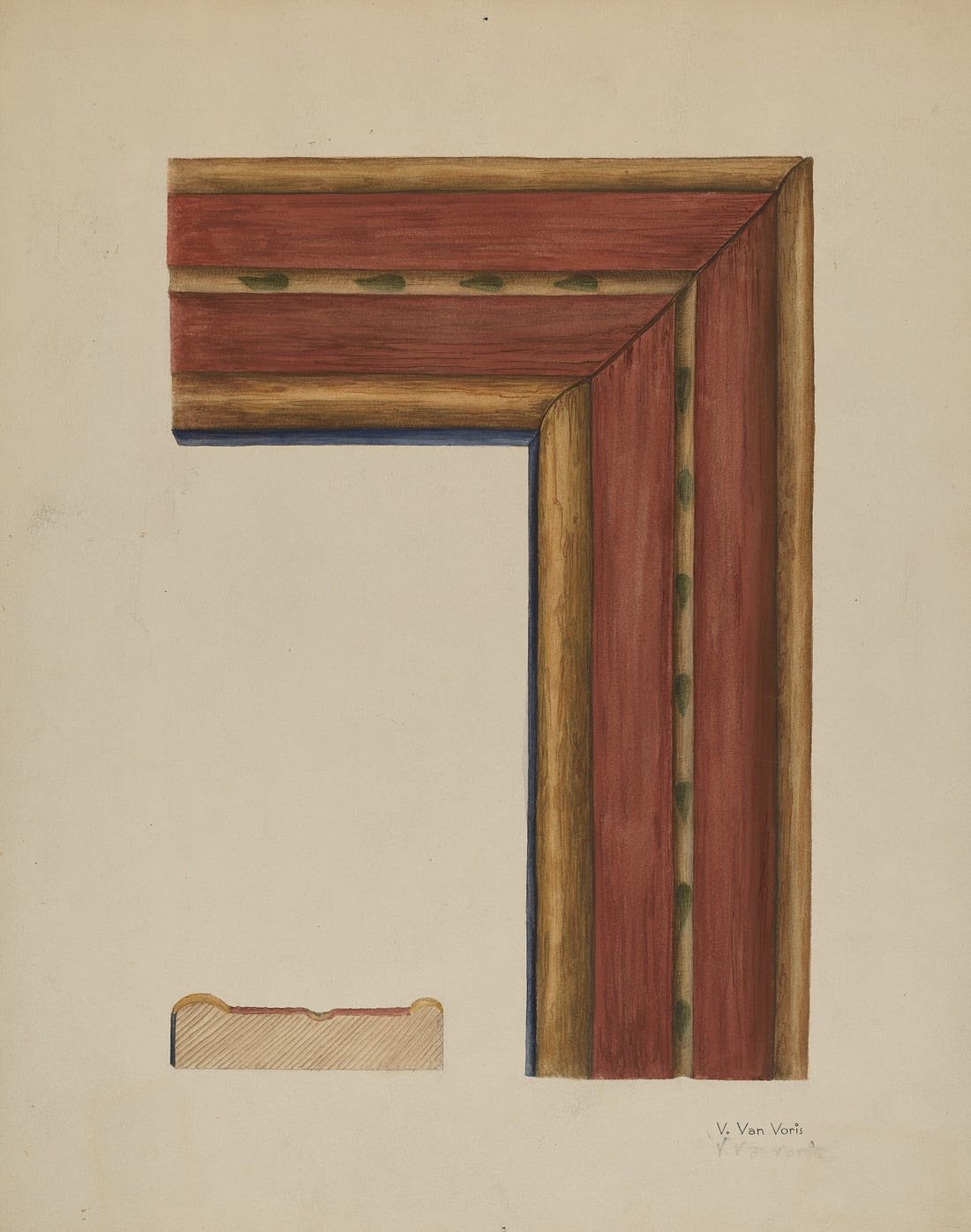
Carved Picture Frame Molding, c. 1938, Vera Van Voris
How does perception “make” our experience and reality?
Much of storytelling and filmmaking is ultimately about this question. After all, how we see determines how we live. If you’ve got the wrong frame on things, you’ll have a wrong perspective—and that skewed or broken perspective will ultimately color how you live your life.
Think of It’s a Wonderful Life, the classic holiday film. George’s framing of things “orients” him, often for the worse. When he sees his home, family, and community through a passive and negative lens—as a series of surrenders to the inevitable and unchosen—his life feels wasted. Clarence, the guardian angel, has to teach George a new perspective on things. He does so by giving George a radically new frame: one that staggers and subverts his perception of things.
It’s perhaps fitting (more than I realized) to watch Laura Dunn’s “Look and See: Further” in the month of January, when we are all tempted to various works of reframing and reorientation (some good, others less than helpful). Ultimately, this film series considers the Berrys’ vision of life, place, and work. In that focus, Laura teaches her viewers much about creation and its call to chosen perception.
The question we must ask ourselves is a question Wendell asks throughout both this series and his work:
What frame are you going to choose?
This post is part of a January series on Laura Dunn’s “Look and See: Further”—a cinematographic exploration of Wendell and Tanya Berry, and their agricultural community in Kentucky. You are welcome to watch the series along with me, but do not need to do so in order to participate in the conversation below!
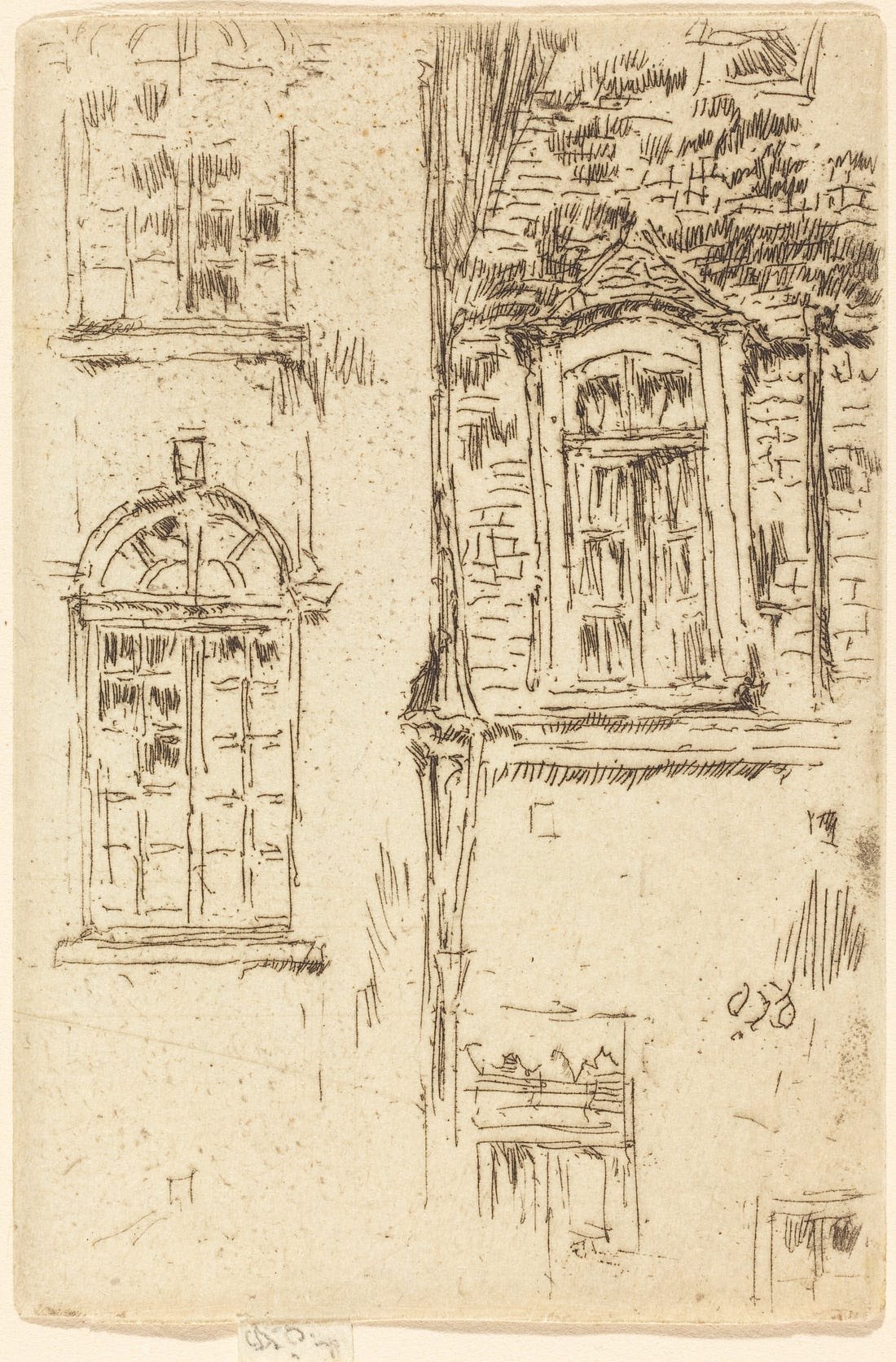
Windows Opposite Hotel, Bourges, 1888, James McNeill Whistler
The first installment in Laura’s series is titled “Love the Work.” It opens with Wendell’s voice, meditating on the fragmentation of human work. We have turned meaningful work into mindless drudgery, Wendell says. This has consequences:
““What we’ve done to work is fragment it, so that the people doing the work didn’t even need to know what they were doing. They didn’t need to know what product they were making. And so they had no responsibility for it, and therefore they could take no pride or satisfaction in doing the work.
”There is, on the other hand… people who love doing their work: who do it out of great liking or great love for it. That’s been my privilege, both in most of the work that I’ve done here on this place, and as both a caretaking and a user of the place, and as a writer. I’ve loved the work—not necessarily every day, but in general I’ve loved doing it. It’s been something to look forward to, not something to dread.””
How much of this love and reverence is determined by the work itself (its worthiness), and how much is determined by the perspective we bring to that work? Wendell suggests that it is a mixture of both. As I noted in my lecture on Tanya Berry, we tend to “name” our work in ways that either demean or elevate it:
“The use of a decent language can change your whole idea of what something is.… Tanya suggested that the right words could change one’s mind. No, more than that—that the right words could change one’s entire perception and experience of a thing. The right language reanimates our work. But to reanimate our work, we must apply a new habit of naming to the things we do.”
This is inherent in Laura’s project: the idea that what we say colors what we see, and that what we see determines what we do. Internal and external, perception and reality are inextricably fused. This puts a great deal of responsibility on us, the humans who interact with specific communities, jobs, and geographies. Our perception will color quotidian tasks and interactions.
Think of The Secret Life of Walter Mitty: so often, we neglect to appreciate the true “quintessence of life,” found in the unseen and the everyday. Those who suffer such neglect may dream of escape via extraordinary adventures and glory. But what they really need is to re-see the world they actually inhabit. Ultimately, this is what happens to Walter Mitty. In a classic T.S. Eliot sense, he finds out that
“the end of all our exploring
Will be to arrive where we started
And know the place for the first time.”
Thus we learn that seeing and knowing things rightly is a vital aspect of good work. We must avoid disordered works of naming or framing.
At the same time, however, Wendell points out that industrial capitalism has divorced many forms of work from their telos, turning humans into machine cogs with no connection to the purpose or value of what they do.
What is perhaps worse, only certain aspects of this framing are within our control. The person working on a factory floor has limited agency. This loss of wholeness and active participation is a problem for those working in the modern world, because they can no longer connect to their world and work in the way past generations did. The fragmentation of labor results (or at least can result) in a broken sense of empowerment and purpose.
The modern world and Industrial Revolution have mitigated dire problems of starvation, want, and scarcity. This is also true, and the one must be acknowledged with the other. We cannot turn back the clock. But with Wendell, we can appraise what is, noting the good and bad together. Perceiving correctly does not mean using rose-colored glasses for everything. That isn’t the right frame. Thanksgiving must be mixed with lament in order to truly hold the broken, beautiful world in which we live.
This, too, is something we see Laura wrestle with as she films “Look and See.” She knows the costs and dangers of film and digital media. She sees the ways technology has both blessed and marred human society. And so she asks Wendell whether certain media or tools “cannot be used for good.”
If we think of technological addiction, the costs of screens, the false perceptions that televisions have introduced into our world, it’s easy to see why Laura, as a filmmaker and director, is asking this.
As Laura asks the question, the episode cuts to a shot of a sycamore tree in the forest. Water stands pooled nearby. Tiny shoots spring up from the forest floor, surrounded by the wet brown leaves of a former season. The camera slowly rotates around the tree, exposing its scarred bark and full green leaves. At one point, we see the shadow of the cameraman silhouetted against the trunk of the tree: viewer and viewed joined, for a moment.
Wendell responds to Laura’s question by noting that every medium has its limits.
“There are certain things that every medium can’t do,” he says. The writer, he notes, cannot show. Writing is inherently a work of “telling.” In contrast, he tells Laura, she must “show a picture, but your whole quest is for the telling picture. Yours is all about showing, but you’re looking for the telling picture.”
“Can an image provoke one’s imagination, or does it deaden it?” Laura asks.
“You’ve already used your imagination not by picking out the picture you’re gonna show, but by determining how you’re gonna show it,” Wendell replies. “I’ve thought a lot about this. The limits of a camera is that it can’t show—it can’t swivel its head all the way around. It’s looking in one direction. And it’s always looking through a frame. Those are significant limitations…. But to determine where to set that lens, where it’s going to look from, requires imagination.… The great photographers are the people who knew where to look from, not necessarily where to look at. That’s the way I think.”
The episode then cuts to a series of vignettes: We see grass blades in summer, speckled with dew. Blush leaves rustle in the wind on an autumn afternoon. Horses prance and dance through a field sparkling with frost. Moonlight pierces the dark silhouette of a tree in winter. Laura presents a symphony of seasons in a single place. Each shot explores movement and stasis, decay and rebirth, within the limits of this landscape. It is a celebration of framing—a composition in which looking from is richly and thoughtfully explored.
Here, too, is a vital lesson: when we embrace our limits, rather than seeking to transcend or defy them, something beautiful happens. True artistry comes from the right and humble use of our broken tools and limited perception. Even if they are imperfect, they can still offer life.
This week, evaluate where you are looking from.
What do you see, and why?
What frames have you constructed for your everyday life?
Where might your stance or perception of things need to shift?
I would love to hear your thoughts.
More on the next episode, “Window Poems,” coming up later in the week!
– Gracy
This article is republished with permission from the author, Gracy Olmstead.